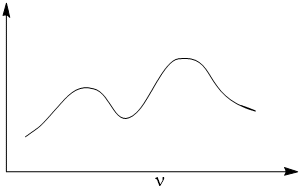
IR Spectra of Fe2(CO)9 (Nonacarbonyldiron)
Why does the IR spectra of Fe2(CO)9 show two νCO bands? Explain.

Fe2(CO)9 contains two distinct structural types of carbonyl ($\text{CO}$) ligands: three bridging $\text{CO}$ groups and six terminal $\text{CO}$ groups.
- Terminal $\text{CO}$ Groups: Have a higher bond order (approximately 3) due to less $\text{d}\pi\rightarrow\text{p}\pi$ back-bonding per ligand. They absorb at higher frequencies ($\mathbf{2010\text{--}2080\text{ cm}^{-1}}$).
- Bridging $\text{CO}$ Groups: Act similarly to inorganic ketonic carbonyl groups with a lower bond order (approximately 2) because back-bonding is shared between two iron atoms. They absorb at lower frequencies ($\mathbf{1820\text{--}1850\text{ cm}^{-1}}$).
Because of the significant difference in bond orders between terminal and bridging carbonyls, Fe2(CO)9 displays two distinct carbonyl stretching (νCO) absorption bands in its infrared spectrum.
Key IR Absorption Bands of Fe2(CO)9
| Vibrational Mode / Bond Type | Wavenumber Range ($\text{cm}^{-1}$) | Characteristic Description |
|---|---|---|
| Terminal Carbonyl (νCO) | 2010 – 2080 $\text{cm}^{-1}$ | Higher frequency, higher bond order ($\sim 3$) |
| Bridging Carbonyl (νCO) | 1820 – 1850 $\text{cm}^{-1}$ | Lower frequency, ketonic nature ($\sim 2$) |
| Metal-Metal Stretch (νFe-Fe) | 550 – 600 $\text{cm}^{-1}$ | Confirms dimeric Fe-Fe single bond |
Metal-Metal (Fe-Fe) Stretching Band in Fe2(CO)9
Another important characteristic band in the infrared spectrum of $\text{Fe}_2(\text{CO})_9$ is the metal-metal stretch band ($\nu_{\text{Fe-Fe}}$), which appears at around 550–600 $\text{cm}^{-1}$. This band directly proves the existence of a metal-metal bond and confirms the dimeric nature of the iron carbonyl complex.