
Orbital angular momentum arises due to the rotation of orbitals. It has been found that orbital angular momentum is partially reduced even in a free ion and further restricted within a crystal field environment.
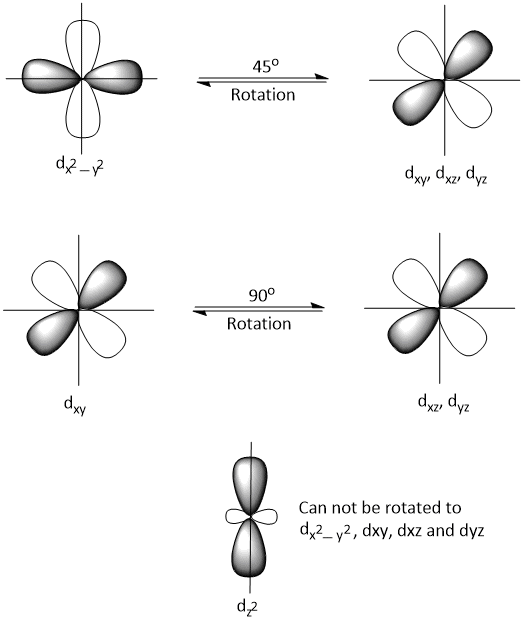
In a free ion, the dxy, dxz, and dyz orbitals can transform into one another via a 90° rotation around the coordinate axes. However, the dx2−y2 orbital cannot be rotated by 45° into the dxy, dxz, or dyz set (and vice-versa) to generate an identical overlapping state, while the dz2 orbital cannot transform into any of them. Consequently, one-fifth of the total orbital angular momentum is intrinsically reduced or quenched even in an isolated free ion state.
When placed inside a coordination complex, the crystal field removes the energy degeneracy, causing the d-orbitals to split:

Because the energy levels of the eg set (dx2−y2, dz2) differ significantly from the t2g set (dxy, dxz, dyz) under the influence of a crystal field, inter-set electron rotations can no longer occur spontaneously without an energy exchange. This constraint imposes an additional quenching of the system's orbital angular momentum.
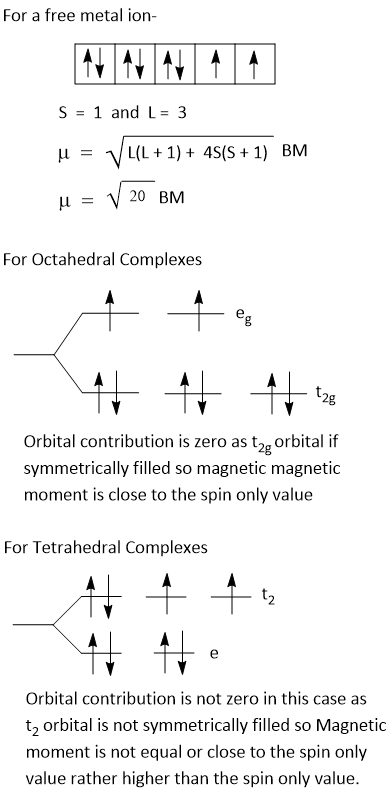
An orbital contribution to the magnetic moment persists exclusively if the sub-orbitals undergoing rotation (the t2g or t2 sets) contain an unsymmetrical electron distribution. If the levels are evenly or symmetrically occupied by electrons—such as in t2g3, t2g6, t23, or t26 configurations—the orbital contribution to the overall magnetic moment is completely quenched. In these cases, the effective magnetic moment (μeff) simplifies to the spin-only formula:

Active orbital contributions are observed only in unsymmetrical configurations like t2g1egx, t2g2egx, t2g4egx, and t2g5egx (or their corresponding tetrahedral t2 arrangements).
Whenever the ground state term in a crystal field is an orbitally degenerate triplet state (T term), the residual orbital angular momentum makes the effective magnetic moment (μeff) significantly greater than the spin-only value (μs). This scenario takes place in weak-field octahedral setups for d1, d4, d6, and d7, tetrahedral setups for d3, d4, d8, and d9, and strong-field octahedral environments for d1, d2, d4, and d5 configurations.
Let's evaluate a high-spin Ni(II) complex (d8 configuration) alongside a Co(II) complex configuration as case studies:


Why does magnetic behavior deviate from the spin-only value in 4d and 5d elements?
In 4d and 5d transition elements, the valence d-orbitals are larger and more spatially extended than 3d orbitals. This allows them to interact much more intensely with incoming ligands, creating exceptionally large crystal field splittings (Δ).
However, because these heavy nuclei hold a massive positive charge, the relativistic movement of core electrons generates a highly powerful intrinsic magnetic field. This creates immense spin-orbit coupling (ζ). This strong internal coupling mixes the spin (S) and orbital (L) angular momentum values heavily, preventing them from behaving as separate vectors. Therefore, the spin-only formula fails for 4d and 5d complexes, requiring a comprehensive consideration of spin-orbit coupling to calculate magnetic moments accurately.
In 4d and 5d heavy transition elements, the simple spin-only magnetic approximation fails primarily because:
- A) Symmetrical ligand fields prevent any interactions with the d-orbitals.
- B) The crystal field splitting values are too low to influence orbital transitions.
- C) Strong spin-orbit coupling effectively mixes spin and orbital angular momentum components.
- D) Heavy nuclei cause all valence d-orbitals to lose their spatial properties completely.
Answer & Explanation
Correct Option: C
While 4d and 5d transition elements experience large ligand fields due to diffuse orbital structures, their magnetic properties are dominated by strong spin-orbit coupling (ζ) due to heavy atom effects. This strong atomic interaction locks the spin and orbital motions together, preventing the simple orbital quenching assumed by the spin-only formula.