
Law of Rational Indices
The law of rational indices was deduced by Hauy.
The law of rational indices states that the intercepts of any face of a crystal along the crystallographic axes are either equal to the unit intercepts or some simple whole number multiples of them.
The faces of crystals and also planes within crystals can be characterized by means of a suitable set of coordinates.
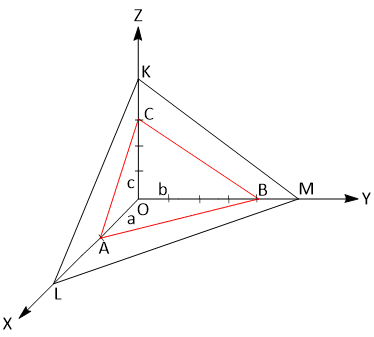
Let consider the three axes OX, OY, OZ which are cut by a crystal face ABC at distances OA, OB, and OC from the origin. Let OX, OY, and OZ represent the three crystallographic axes and let ABC be a unit plane. The unit intercepts will then be a, b and c.
According to the above law, the intercepts of any face such as KLM, on the same three Axes will be simple whole number multiples of a, b and c respectively. These distances are called intercepts. It is found that if the axes are suitably chosen, the intercepts of different faces upon them bear a simple ratio to each other or a given face may cut an axis at infinity. This is called the law of rational intercepts or indices.
Test Your Knowledge
Q1. The Law of Rational Indices states that the intercepts of crystal faces along crystallographic axes are:
- A. Always irrational numbers
- B. Simple whole number multiples of unit intercepts
- C. Random values depending on crystal growth
- D. Fractions with denominators greater than 10
Answer & Explanation
Correct Answer: B
According to Hauy’s Law of Rational Indices, the intercepts of crystal faces are either equal to the unit intercepts or simple whole number multiples of them. This ensures that crystal geometry follows rational proportions, not random or irrational values.
Q2. If a crystal face cuts the axes at 2a, 3b, and c, the intercepts are expressed as:
- A. (2, 3, 1)
- B. (a, b, c)
- C. (1/2, 1/3, 1)
- D. (∞, ∞, ∞)
Answer & Explanation
Correct Answer: A
The intercepts are written as multiples of the unit intercepts (a, b, c). Here, the face cuts at 2a, 3b, and c, so the intercepts are represented as (2, 3, 1). This follows the law of rational indices where ratios remain simple whole numbers.
Q3. A crystal face parallel to the Y-axis will have its intercept along Y as:
- A. Zero
- B. Infinity
- C. One
- D. Undefined
Answer & Explanation
Correct Answer: B
When a crystal face is parallel to an axis, it never intersects that axis. In crystallography, this is represented as an intercept at infinity. Hence, the intercept along Y is ∞.
Related Topics
🔗 Miller Indices
🔗 Weiss Indices