
Karnataka School Examination and Assessment Board
II PUC Model Question Paper - 5 Solutions
Subject: 34 - Chemistry | Max Marks: 70
Instructions
- Question paper has FIVE parts. All parts are compulsory.
-
a. Part-A carries 20 marks. Each question carries 1 mark.
b. Part-B carries 06 marks. Each question carries 2 marks.
c. Part-C carries 15 marks. Each question carries 3 marks.
d. Part-D carries 20marks. Each question carries 5 marks.
e. Part-E carries 09 marks. Each question carries 3 marks. - In Part-A questions, first attempted answer will be considered for awarding marks.
- Write balanced chemical equations and draw neat labeled diagrams and graphs wherever necessary.
- Direct answers to the numerical problems without detailed steps and specific unit for final answer will not carry any marks.
- Use log tables and simple calculator if necessary (use of scientific calculator is not allowed).
- For a question having circuit diagram/figure/ graph/ diagram, alternate questions are given at the end of question paper in a separate section for visually challenged students.
PART - A
I. Multiple Choice Questions (15 × 1 = 15 Marks)
1. When converting a disaccharide to monosaccharides, the bond that is hydrolysed is
Answer: (b) Glycosidic bond
2. If molality of the dilute solution is doubled, the value of the molal depression constant (Kf) will be
Answer: (d) unchanged
Reason: Molal depression constant (Kf) depends only on the nature of the solvent, not on the concentration/molality of the solution.
Reason: Molal depression constant (Kf) depends only on the nature of the solvent, not on the concentration/molality of the solution.
3. The relation between crystal field splitting energy of octahedral and tetrahedral complexes is
Answer: (a) Δt = (4/9)Δo
4. The reducing agent used to reduce carboxylic to primary alcohols in excellent yield is
Answer: (b) LiAlH4
5. A plot between ln K vs 1/T, the slope is equal to
Answer: (c) -Ea/R
6. The correct order of basic strength in case of ethyl substituted amines and ammonia in aqueous solution is:
Answer: (a) (C2H5)2NH > (C2H5)3N > C2H5NH2 > NH3
7. Aniline undergoes bromination with excess bromine water to give 2,4,6-tribromoaniline. To obtain monobromoaniline as the major product, which sequence of reactions should be followed?
Answer: (b) acetylating the amino group followed by bromination and hydrolysis
8. Which of the following statement is not true about the acidic nature of carboxylic acids?
Answer: (b) The presence of electron donating group on the phenyl ring of aromatic carboxylic acid increases their acidity.
Reason: Electron-donating groups decrease acidity, while electron-withdrawing groups increase acidity.
Reason: Electron-donating groups decrease acidity, while electron-withdrawing groups increase acidity.
9. The pair of electrolytes that possess same value for the constant (A) in the Λm = Λm0 - A√C
Answer: (a) NH4Cl, NaBr
Reason: Both are 1-1 type electrolytes, so they have the same value for constant A.
Reason: Both are 1-1 type electrolytes, so they have the same value for constant A.
10. Match the coordination compounds given in column I with type of isomerism exhibited by them in column II:
Answer: (a) i → B, ii → D, iii → A, iv → C
- [Co(en)3]Cl3 → Optical isomerism
- [Co(NH3)6][Cr(CN)6] → Coordination isomerism
- [Co(NH3)5(SCN)]+2 → Linkage isomerism
- [Co(NH3)4Cl2]+ → Geometrical isomerism
11. Two compounds 'A' and 'B' were being tested for their boiling points. It was observed that 'A' started boiling after 'B', when both were subjected to same conditions. If the compound 'B' is acetone, which of the following can be compound 'A'?
Answer: (b) Propan-1-ol
Reason: Propan-1-ol exhibits strong intermolecular hydrogen bonding, giving it a higher boiling point than acetone, so it boils after acetone.
Reason: Propan-1-ol exhibits strong intermolecular hydrogen bonding, giving it a higher boiling point than acetone, so it boils after acetone.
12. The haloarene cannot be prepared from Sandmeyer's reaction is
Answer: (c) C6H5-F
13. Although +3 is the characteristic oxidation state for lanthanoids but cerium also shows +4 oxidation state because of
Answer: (c) Cerium +4 has noble gas configuration 4f05d06s0.
14. During osmosis, the solvent molecules are moving from
Answer: (a) Hypotonic solution to hypertonic solution
15. The chemical formula of glycerol is,
Answer: (d) C3H8O3
II. Fill in the blanks by choosing the appropriate word from those given in the brackets: (Scandium, Zn, phosphodiester, increases, decreases, geminal dihalide) (5 × 1 = 5 Marks)
16. At the same partial pressure and temperature as the value of Henry's constant of a gas increases its solubility decreases.
17. Most of the transition metals forms ionic oxides except Zn.
18. Ethylidene chloride is a geminal dihalide.
19. Electron accepting group increases acidity of phenol.
20. Nucleotides are joined together by phosphodiester linkage between 5' and 3' carbon atoms of pentose sugar.
17. Most of the transition metals forms ionic oxides except Zn.
18. Ethylidene chloride is a geminal dihalide.
19. Electron accepting group increases acidity of phenol.
20. Nucleotides are joined together by phosphodiester linkage between 5' and 3' carbon atoms of pentose sugar.
PART - B
III. Answer any three questions (3 × 2 = 6 Marks)
21. What are freons? Give an example. [2 Marks]
Freons: Freons are chlorofluorocarbon compounds (CFCs) derived from methane and ethane.
Example: Freon-12 (CF2Cl2 - dichlorodifluoromethane).
Example: Freon-12 (CF2Cl2 - dichlorodifluoromethane).
22. What are the two conditions for effective collision? [2 Marks]
1. The colliding molecules must possess a minimum energy equal to the activation energy (Ea).
2. The reacting molecules must collide with proper orientation.
2. The reacting molecules must collide with proper orientation.
23. Name two functions of glucocorticoids. [2 Marks]
1. Regulate carbohydrate, protein, and fat metabolism in the body.
2. Possess anti-inflammatory properties and suppress the immune system response.
2. Possess anti-inflammatory properties and suppress the immune system response.
24. Earlier members of Lanthanides are quite reactive, similar to element A and with increasing atomic number, Lanthanoids behave more like element B. Identify A & B elements. [2 Marks]
Element A = Calcium (Ca)
Element B = Aluminum (Al)
Element B = Aluminum (Al)
25. Explain preparation of phenol from isopropyl benzene with chemical equation. [2 Marks]
Isopropyl benzene (cumene) is oxidized by air into cumene hydroperoxide, which on treatment with dilute acid decomposes to form phenol and acetone.
C6H5-CH(CH3)2 + O2 → C6H5-C(CH3)2-O-O-H
C6H5-C(CH3)2-O-O-H + H+/H2O → C6H5OH + CH3COCH3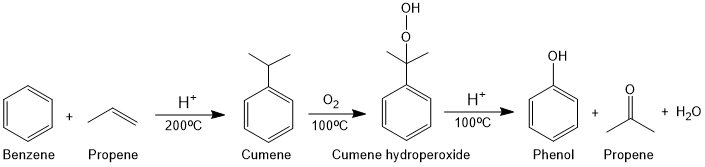
C6H5-CH(CH3)2 + O2 → C6H5-C(CH3)2-O-O-H
C6H5-C(CH3)2-O-O-H + H+/H2O → C6H5OH + CH3COCH3
PART - C
IV. Answer any three questions (3 × 3 = 9 Marks)
26. Give two reasons to justify catalytic property of transition elements. Name the catalyst used in Wacker process. [3 Marks]
Reasons for catalytic property:
- Presence of vacant d-orbitals and variable oxidation states.
- Ability to provide a large surface area for reactants to get adsorbed.
27. Write the geometrical isomers of the complex [MX2(L-L)2]. Identify the optically inactive form of it. [3 Marks]
The complex [MX2(L-L)2] exhibits two geometrical isomers:
- cis-isomer: The two monodentate ligands (X) are adjacent to each other.
- trans-isomer: The two monodentate ligands (X) are opposite to each other.
28. Write any three limitations of valence band theory of coordination compounds. [3 Marks]
- It gives no quantitative interpretation of magnetic data.
- It cannot explain the electronic spectra / color displayed by coordination complexes.
- It does not distinguish clearly between weak field and strong field ligands.
29. Write the balanced chemical equations for the following reactions: [3 Marks]
i) Cr2O72- + 14H+ + 6I- → 2Cr3+ + 7H2O + 3I2
ii) 2MnO4- + H2O + I- → 2MnO2 + 2OH- + IO3-
iii) 2MnO4- + 5C2O42- + 16H+ → 2Mn2+ + 10CO2 + 8H2O
ii) 2MnO4- + H2O + I- → 2MnO2 + 2OH- + IO3-
iii) 2MnO4- + 5C2O42- + 16H+ → 2Mn2+ + 10CO2 + 8H2O
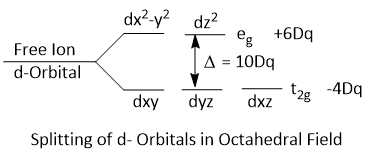
30. Draw energy level diagram of crystal field splitting in octahedral complex. Write the electronic configuration of d4 system when P > Δo. [3 Marks]
Crystal Field Splitting in Octahedral Field:
In an octahedral field, five degenerate d-orbitals split into two sets: lower energy t2g orbitals (dxy, dyz, dzx) and higher energy eg orbitals (dx2-y2, dz2).
 Electronic configuration for d4 system when P > Δo (Low spin):
Since Pairing energy P > Δo, pairing occurs in t2g orbitals before eg is filled.
Configuration: t2g4 eg0
In an octahedral field, five degenerate d-orbitals split into two sets: lower energy t2g orbitals (dxy, dyz, dzx) and higher energy eg orbitals (dx2-y2, dz2).
Electronic configuration for d4 system when P > Δo (Low spin):Since Pairing energy P > Δo, pairing occurs in t2g orbitals before eg is filled.
Configuration: t2g4 eg0
V. Answer any two questions (2 × 3 = 6 Marks)
31. Define half-life period? Show that half-life period of first order reaction is independent on initial concentration of reactant. [3 Marks]
Half-life period (t1/2): It is the time required for the concentration of a reactant to reduce to half of its initial value.
Derivation:
For a first-order reaction: k = (2.303 / t) × log([R]0 / [R])
At t = t1/2, [R] = [R]0 / 2
k = (2.303 / t1/2) × log([R]0 / ([R]0 / 2))
k = (2.303 / t1/2) × log(2)
k = (2.303 × 0.3010) / t1/2 = 0.693 / t1/2
t1/2 = 0.693 / k
Hence, t1/2 is independent of the initial concentration [R]0.
Derivation:
For a first-order reaction: k = (2.303 / t) × log([R]0 / [R])
At t = t1/2, [R] = [R]0 / 2
k = (2.303 / t1/2) × log([R]0 / ([R]0 / 2))
k = (2.303 / t1/2) × log(2)
k = (2.303 × 0.3010) / t1/2 = 0.693 / t1/2
t1/2 = 0.693 / k
Hence, t1/2 is independent of the initial concentration [R]0.
32. Plot the graph of molar conductivity vs concentration for KCl and acetic acid. Which electrolyte's limiting molar conductivity can be determined by this graph? [3 Marks]
Graph description: Plotting Λm vs √C gives a straight line with a negative slope for strong electrolyte (KCl) and a steep curve at low concentration for weak electrolyte (acetic acid, CH3COOH).
 Answer: The limiting molar conductivity (Λm0) of KCl (strong electrolyte) can be determined by extrapolating the graph to zero concentration.
33. In a laboratory experiment, a student dissolves 6 g of urea in 180 g of water at constant temperature and observes that the vapour pressure of the solution is lower than that of pure water. Name the law that explains this observation, state the law, and write its mathematical expression. [3 Marks]
Law Name: Raoult's Law for non-volatile solutes.
Statement: The relative lowering of vapour pressure of a dilute solution containing a non-volatile solute is equal to the mole fraction of the solute present in the solution.
Mathematical Expression:
(p0 - p) / p0 = x2 = n2 / (n1 + n2) = (w2 × M1) / (M2 × w1)
Statement: The relative lowering of vapour pressure of a dilute solution containing a non-volatile solute is equal to the mole fraction of the solute present in the solution.
Mathematical Expression:
(p0 - p) / p0 = x2 = n2 / (n1 + n2) = (w2 × M1) / (M2 × w1)
34. Name the electrolytes used in Mercury cell. Write its anodic and cathodic reactions. [3 Marks]
Electrolyte: A paste of KOH and ZnO.
Anode reaction: Zn(Hg) + 2OH- → ZnO(s) + H2O + 2e-
Cathode reaction: HgO(s) + H2O + 2e- → Hg(l) + 2OH-
Anode reaction: Zn(Hg) + 2OH- → ZnO(s) + H2O + 2e-
Cathode reaction: HgO(s) + H2O + 2e- → Hg(l) + 2OH-
PART - D
VI. Answer any four questions (4 × 5 = 20 Marks)
35. (a) Write the IUPAC name and structure of DDT. Give the reason, why the use of DDT increased enormously on a worldwide basis after World War II. (3 Marks)
(b) Explain Wurtz-Fittig reaction for the preparation of toluene with chemical reaction. (2 Marks)
(b) Explain Wurtz-Fittig reaction for the preparation of toluene with chemical reaction. (2 Marks)
(a)
IUPAC Name of DDT: 2,2-bis(4-chlorophenyl)-1,1,1-trichloroethane.
Structure: (C6H4Cl)2CH-CCl3
 Reason: DDT was found to be extremely effective against mosquitoes carrying malaria and lice carrying typhus during and after World War II.
(b) Wurtz-Fittig Reaction:
When a mixture of chlorobenzene and methyl chloride is treated with sodium metal in dry ether, toluene is formed.
C6H5Cl + 2Na + CH3Cl → C6H5-CH3 + 2NaCl
IUPAC Name of DDT: 2,2-bis(4-chlorophenyl)-1,1,1-trichloroethane.
Structure: (C6H4Cl)2CH-CCl3
Reason: DDT was found to be extremely effective against mosquitoes carrying malaria and lice carrying typhus during and after World War II.(b) Wurtz-Fittig Reaction:
When a mixture of chlorobenzene and methyl chloride is treated with sodium metal in dry ether, toluene is formed.
C6H5Cl + 2Na + CH3Cl → C6H5-CH3 + 2NaCl
36. (a) Which disaccharide is also known as invert sugar? Write the Haworth structure of it. (3 Marks)
(b) What are non-essential amino acid? Give an example for optically inactive non-essential amino acid. (2 Marks)
(b) What are non-essential amino acid? Give an example for optically inactive non-essential amino acid. (2 Marks)
(a)
Invert Sugar: Sucrose.
Haworth Structure: Sucrose consists of α-D-glucopyranose and β-D-fructofuranose linked by C1-C2 glycosidic linkage. (b)
(b)
Non-essential amino acids: Amino acids that can be synthesized in the human body and do not need to be supplied through diet.
Optically inactive non-essential amino acid: Glycine.
Invert Sugar: Sucrose.
Haworth Structure: Sucrose consists of α-D-glucopyranose and β-D-fructofuranose linked by C1-C2 glycosidic linkage.
(b)Non-essential amino acids: Amino acids that can be synthesized in the human body and do not need to be supplied through diet.
Optically inactive non-essential amino acid: Glycine.
37. (a) Name the chemical reaction that differentiates ethanal and propanal. Write chemical reaction of it. (3 Marks)
(b) Explain Kolbe electrolysis reaction for sodium acetate. (2 Marks)
(b) Explain Kolbe electrolysis reaction for sodium acetate. (2 Marks)
(a)
Reaction: Iodoform Test (Haloform Reaction). Ethanal gives a yellow precipitate of iodoform, whereas propanal does not.
CH3CHO + 3I2 + 4NaOH → CHI3↓ (Yellow ppt) + HCOONa + 3NaI + 3H2O
(b) Kolbe's Electrolysis:
An aqueous solution of sodium acetate on electrolysis yields ethane at the anode.
2CH3COONa + 2H2O → C2H6 + 2CO2 + H2 + 2NaOH
Reaction: Iodoform Test (Haloform Reaction). Ethanal gives a yellow precipitate of iodoform, whereas propanal does not.
CH3CHO + 3I2 + 4NaOH → CHI3↓ (Yellow ppt) + HCOONa + 3NaI + 3H2O
(b) Kolbe's Electrolysis:
An aqueous solution of sodium acetate on electrolysis yields ethane at the anode.
2CH3COONa + 2H2O → C2H6 + 2CO2 + H2 + 2NaOH
38. (a) Write the structures of the products obtained when aniline undergoes nitration at 288 K. (3 Marks)
(b) Name one electrophilic substitution reaction that aniline do not undergo. Justify your answer. (2 Marks)
(b) Name one electrophilic substitution reaction that aniline do not undergo. Justify your answer. (2 Marks)
(a) Products of Aniline Nitration:
At 288 K, nitration of aniline produces a mixture of three isomers: (b) Reaction not undergone: Friedel-Crafts reaction (alkylation or acylation).
Justification: Aniline forms a salt with the Lewis acid catalyst (AlCl3), as C6H5NH2 + AlCl3 → C6H5NH2+-AlCl3-. This introduces a strong electron-withdrawing group, deactivating the benzene ring toward further electrophilic substitution.
At 288 K, nitration of aniline produces a mixture of three isomers:
- p-nitroaniline (51%)
- m-nitroaniline (47%)
- o-nitroaniline (2%)
(b) Reaction not undergone: Friedel-Crafts reaction (alkylation or acylation).Justification: Aniline forms a salt with the Lewis acid catalyst (AlCl3), as C6H5NH2 + AlCl3 → C6H5NH2+-AlCl3-. This introduces a strong electron-withdrawing group, deactivating the benzene ring toward further electrophilic substitution.
39. (a) Write the steps involved in the mechanism of acid catalysed hydration of ethene to ethanol. (3 Marks)
(b) Write the product/s obtained when 2-methoxy-2-methylpropane reacts with HI. (2 Marks)
(b) Write the product/s obtained when 2-methoxy-2-methylpropane reacts with HI. (2 Marks)
(a) Mechanism of Hydration of Ethene:
(CH3)3C-O-CH3 + HI → (CH3)3C-I + CH3OH
Products: tert-butyl iodide and methanol.
- Step 1: Protonation of alkene to form carbocation by electrophilic attack of H3O+:
CH2=CH2 + H3O+ → CH3-CH2+ + H2O - Step 2: Nucleophilic attack of water on carbocation:
CH3-CH2+ + H2O → CH3-CH2-OH2+ - Step 3: Deprotonation to form alcohol:
CH3-CH2-OH2+ + H2O → CH3-CH2-OH + H3O+
(CH3)3C-O-CH3 + HI → (CH3)3C-I + CH3OH
Products: tert-butyl iodide and methanol.
40. (a) What is the chemical composition of Rochelle salt? How does it react with benzaldehyde? (3 Marks)
(b) Write the chemical reaction between cyclohexene and hot acidified KMnO4. Write the IUPAC name of the product formed in this reaction. (2 Marks)
(b) Write the chemical reaction between cyclohexene and hot acidified KMnO4. Write the IUPAC name of the product formed in this reaction. (2 Marks)
(a)
Composition: Potassium Sodium Tartrate tetrahydrate (KNaC4H4O6·4H2O). It is a component of Fehling's solution B.
Reaction with Benzaldehyde: Benzaldehyde is an aromatic aldehyde and does not reduce Fehling's solution (Rochelle salt); hence, no reaction occurs.
(b) Oxidation of Cyclohexene:
Cyclohexene + 4[O] (hot acidified KMnO4) → HOOC-(CH2)4-COOH
IUPAC Name: Hexane-1,6-dioic acid (Adipic acid).
Composition: Potassium Sodium Tartrate tetrahydrate (KNaC4H4O6·4H2O). It is a component of Fehling's solution B.
Reaction with Benzaldehyde: Benzaldehyde is an aromatic aldehyde and does not reduce Fehling's solution (Rochelle salt); hence, no reaction occurs.
(b) Oxidation of Cyclohexene:
Cyclohexene + 4[O] (hot acidified KMnO4) → HOOC-(CH2)4-COOH
IUPAC Name: Hexane-1,6-dioic acid (Adipic acid).
PART - E (PROBLEMS)
VII. Answer any three questions (3 × 3 = 9 Marks)
41. In a reaction, 2A → R, the concentration of A decreases from 0.5 mol L-1 to 0.4 mol L-1 in 10 minutes. Calculate the rate during this interval? [3 Marks]
Given:
[A]1 = 0.5 mol L-1
[A]2 = 0.4 mol L-1
Δt = 10 min
Formula:
Rate = -(1/2) × (Δ[A] / Δt)
Δ[A] = [A]2 - [A]1 = 0.4 - 0.5 = -0.1 mol L-1
Calculation:
Rate = -(1/2) × (-0.1 / 10)
Rate = 0.1 / 20 = 0.005 mol L-1 min-1 (or 5 × 10⁻³ mol L-1 min-1)
[A]1 = 0.5 mol L-1
[A]2 = 0.4 mol L-1
Δt = 10 min
Formula:
Rate = -(1/2) × (Δ[A] / Δt)
Δ[A] = [A]2 - [A]1 = 0.4 - 0.5 = -0.1 mol L-1
Calculation:
Rate = -(1/2) × (-0.1 / 10)
Rate = 0.1 / 20 = 0.005 mol L-1 min-1 (or 5 × 10⁻³ mol L-1 min-1)
42. At same temperature, 6% of urea is isotonic with 5% solution of unknown non-electrolyte A. Calculate the molar mass of unknown non-electrolyte A. (molar mass of urea 60 g mol-1) [3 Marks]
For isotonic solutions, osmotic pressure π1 = π2, so C1 = C2.
(w1 / (M1 × V)) = (w2 / (M2 × V))
Given:
Urea solution (1): w1 = 6 g, M1 = 60 g/mol
Unknown A (2): w2 = 5 g, M2 = ?
Calculation:
6 / 60 = 5 / M2
0.1 = 5 / M2
M2 = 5 / 0.1 = 50 g mol-1
(w1 / (M1 × V)) = (w2 / (M2 × V))
Given:
Urea solution (1): w1 = 6 g, M1 = 60 g/mol
Unknown A (2): w2 = 5 g, M2 = ?
Calculation:
6 / 60 = 5 / M2
0.1 = 5 / M2
M2 = 5 / 0.1 = 50 g mol-1
43. An electric current of 100 ampere is passed through a molten liquid of sodium chloride for 5 hours. Calculate the volume of chlorine gas liberated at the electrode at NTP. [3 Marks]
Given:
I = 100 A
t = 5 hours = 5 × 3600 = 18000 seconds
Q = I × t = 100 × 18000 = 1,800,000 C
Reaction at anode:
2Cl- → Cl2(g) + 2e-
2 moles of e- (2 × 96500 C = 193000 C) liberate 1 mole of Cl2 gas.
Moles of Cl2 = 1,800,000 / 193,000 = 9.326 moles
At NTP, volume of 1 mole of gas = 22.4 L
Volume of Cl2 liberated:
V = 9.326 × 22.4 = 208.9 L
I = 100 A
t = 5 hours = 5 × 3600 = 18000 seconds
Q = I × t = 100 × 18000 = 1,800,000 C
Reaction at anode:
2Cl- → Cl2(g) + 2e-
2 moles of e- (2 × 96500 C = 193000 C) liberate 1 mole of Cl2 gas.
Moles of Cl2 = 1,800,000 / 193,000 = 9.326 moles
At NTP, volume of 1 mole of gas = 22.4 L
Volume of Cl2 liberated:
V = 9.326 × 22.4 = 208.9 L
44. The vapour pressure (in Atm) curve for solution containing non-volatile solid substance 'G' and pure solvent is plotted against temperature (in K) as shown in figure. Calculate the molality of the solution. (Kb for water is 0.52 K kg mol-1). [3 Marks]

From the graph given:
Boiling point of pure solvent (Tb0) = 373.15 K
Boiling point of solution (Tb) = 373.202 K
Elevation in boiling point (ΔTb):
ΔTb = Tb - Tb0 = 373.202 - 373.15 = 0.052 K
Formula:
ΔTb = Kb × m
0.052 = 0.52 × m
m = 0.052 / 0.52 = 0.1 mol/kg (or 0.1 m)
Boiling point of pure solvent (Tb0) = 373.15 K
Boiling point of solution (Tb) = 373.202 K
Elevation in boiling point (ΔTb):
ΔTb = Tb - Tb0 = 373.202 - 373.15 = 0.052 K
Formula:
ΔTb = Kb × m
0.052 = 0.52 × m
m = 0.052 / 0.52 = 0.1 mol/kg (or 0.1 m)
45. The rate constant of a first order reaction increases from 2×10⁻² s-1 to 4×10⁻² s-1 when the temperature changes from 300 K to 310 K. Calculate the energy of activation (Ea) [log 2 = 0.3010, R = 8.314 J K-1 mol-1] [3 Marks]
Arrhenius Equation:
log(k2 / k1) = (Ea / (2.303 × R)) × [(T2 - T1) / (T1 × T2)]
Given:
k1 = 2 × 10⁻² s-1, k2 = 4 × 10⁻² s-1
T1 = 300 K, T2 = 310 K
k2 / k1 = 4/2 = 2
Calculation:
log(2) = (Ea / (2.303 × 8.314)) × [(310 - 300) / (300 × 310)]
0.3010 = (Ea / 19.147) × [10 / 90000]
0.3010 = Ea × (10 / 1723230)
Ea = (0.3010 × 1723230) / 10
Ea = 51849.2 J mol-1 = 51.85 kJ mol-1
log(k2 / k1) = (Ea / (2.303 × R)) × [(T2 - T1) / (T1 × T2)]
Given:
k1 = 2 × 10⁻² s-1, k2 = 4 × 10⁻² s-1
T1 = 300 K, T2 = 310 K
k2 / k1 = 4/2 = 2
Calculation:
log(2) = (Ea / (2.303 × 8.314)) × [(310 - 300) / (300 × 310)]
0.3010 = (Ea / 19.147) × [10 / 90000]
0.3010 = Ea × (10 / 1723230)
Ea = (0.3010 × 1723230) / 10
Ea = 51849.2 J mol-1 = 51.85 kJ mol-1
46. Calculate the emf of the cell in which the following reaction takes place: Ni(s) + 2Ag+(0.002M) → Ni2+(0.160M) + 2Ag(s). Given Eocell = 1.05 V. [3 Marks]
Nernst Equation:
Ecell = Eocell - (0.0591 / n) × log([Ni2+] / [Ag+]2)
Given:
n = 2
[Ni2+] = 0.160 M
[Ag+] = 0.002 M = 2 × 10⁻³ M
Calculation:
[Ni2+] / [Ag+]2 = 0.160 / (2 × 10⁻³)2 = 0.160 / (4 × 10⁻⁶) = 40,000 = 4 × 10⁴
log(40000) = log(4) + 4 = 0.6020 + 4 = 4.6020
Ecell = 1.05 - (0.0591 / 2) × 4.6020
Ecell = 1.05 - (0.02955 × 4.6020)
Ecell = 1.05 - 0.136 = 0.914 V
Ecell = Eocell - (0.0591 / n) × log([Ni2+] / [Ag+]2)
Given:
n = 2
[Ni2+] = 0.160 M
[Ag+] = 0.002 M = 2 × 10⁻³ M
Calculation:
[Ni2+] / [Ag+]2 = 0.160 / (2 × 10⁻³)2 = 0.160 / (4 × 10⁻⁶) = 40,000 = 4 × 10⁴
log(40000) = log(4) + 4 = 0.6020 + 4 = 4.6020
Ecell = 1.05 - (0.0591 / 2) × 4.6020
Ecell = 1.05 - (0.02955 × 4.6020)
Ecell = 1.05 - 0.136 = 0.914 V
PART - F (For visually challenged students only)
44. The vapour pressure of pure liquids A and B are 450 and 700 mm Hg respectively, at 350 K. Find out the composition of the liquid A if total vapour pressure is 600 mm Hg. [3 Marks]
Given:
pA0 = 450 mm Hg, pB0 = 700 mm Hg, Ptotal = 600 mm Hg
Formula:
Ptotal = pA + pB = xA·pA0 + xB·pB0
Since xB = 1 - xA:
600 = xA(450) + (1 - xA)(700)
600 = 450 xA + 700 - 700 xA
600 = 700 - 250 xA
250 xA = 100
xA = 100 / 250 = 0.40
The composition of liquid A in liquid phase is mole fraction xA = 0.40 (or 40 mol%).
pA0 = 450 mm Hg, pB0 = 700 mm Hg, Ptotal = 600 mm Hg
Formula:
Ptotal = pA + pB = xA·pA0 + xB·pB0
Since xB = 1 - xA:
600 = xA(450) + (1 - xA)(700)
600 = 450 xA + 700 - 700 xA
600 = 700 - 250 xA
250 xA = 100
xA = 100 / 250 = 0.40
The composition of liquid A in liquid phase is mole fraction xA = 0.40 (or 40 mol%).
Must Read Karnataka II PUC Solved Biology Model Question Paper 2027