
Applications or Significance of Dipole Moment
Dipole moments play an important role in understanding the nature of chemical bonds and the overall polarity of molecules. They provide valuable insight into the distribution of charge within a molecule, which in turn affects its physical and chemical properties. Some important applications of dipole moments are discussed below:
Determination of Bond Moment
The contribution of an individual bond towards the dipole moment of a polyatomic molecule is called the bond moment, as the total dipole moment is the vectorial sum of individual bond moments. For example, the dipole moment of water is 1.85D.

Hence, the bond moment of the O—H bond in H2O is calculated by using Lami's theorem of three coplanar forces in equilibrium as shown below:

Determination of % Ionic Character of a Bond
Polar compounds have ionic as well as covalent character. The ionic character arises due to polarity in the bond, which can be evaluated from the experimentally determined dipole moment.
In HCl, the bond distance is 1.26Å and the observed dipole moment is 1.03D. If the charge (δ) is assumed to be 1 complete unit, then the calculated theoretical dipole moment (μcal) will be:
Using the actual observed experimental value of 1.03D, the % ionic character of the HCl bond is computed as:
This explicitly means that HCl is roughly 17% ionic and 83% covalent. Ionic character naturally increases as the electronegativity difference between the bonded atoms increases. Thus, HF is the most ionic and HI is the least ionic among the HX halogen molecules.
Distinction of cis-trans Isomers
In most cases, the dipole moment of a cis-isomer has a higher value than its more symmetrical trans-counterpart. This happens because the cis-isomer is quite polar since functional group vectors point to the same side of the molecule and do not completely cancel out.

Examples:
- Dichloroethylene: cis: 1.56D | trans: 0.3D
- 1,2-dichloroethene: cis: 1.86D | trans: 0D
- 1,2-dibromoethene: cis: 1.35D | trans: 0D

Determination of Structure of Molecules
Symmetrical molecules hold a net zero dipole moment. All monoatomic molecules are inherently symmetrical because their dipole moment is zero. Homonuclear diatomic molecules also have zero dipole moment and are symmetrical linear molecules. Heteronuclear diatomic molecules remain linear but possess clear dipole moments due to electronegativity variances.
AB2 type molecules can exist in either linear or angular structures. For example, both CO2 and H2O are AB2 type molecules; however, CO2 is linear because its net dipole moment is zero, whereas H2O is angular with a value of 1.85D. Similarly, the dipole moment of CCl4 is zero, meaning it adopts a perfectly symmetrical tetrahedral framework.
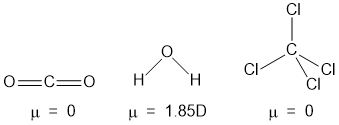
Molecules displaying completely symmetrical geometry completely lack a net dipole moment. Common examples include: CO2, CS2, C2H4, CCl4, and SnCl4.
Distinction Between ortho, meta and para-Isomers
By using the law of parallelogram of forces across aromatic isomers, we can isolate precise mathematical values:

R2 = P2 + Q2 + 2PQ cosθ
or, R2 = P2 + P2 + 2P2 × 1/2 = 3P2
∴ R = √3P = √3 × 3.9 = 6.63D
μcal = 6.63D | μobs = 6.00D
R2 = P2 + P2 + 2PQ cosθ
or, R2 = P2 + P2 + 2P2 × (−1/2) = P2
∴ R = P = 3.90D
μcal = 3.90D | μobs = 3.90D
R2 = P2 + P2 + 2PQ cosθ
or, R2 = P2 + P2 + 2P2 × (−1) = 0
∴ R = 0
μcal = 0 | μobs = 0
The NO2 group has an isolated dipole moment of 3.9D. The minor variance in real observed μ values for the ortho-isomer is due to mutual steric and electronic repulsion between the two adjacent NO2 groups. Hence, the actual real bond angle expands slightly past 60°.
Explanation of the Behaviour of Solutions and Gases
Dipole moments are highly descriptive during interpretations of solution and gas phase behaviors when they drift away from expected ideal state actions.
Explanation of Solubilities
Evaluating standard molecular dipole parameters clarifies the solubility mechanics of compounds. Polar molecules show rapid dissolution inside polar mediums like water, whereas nonpolar compounds integrate cleanly within organic solvents.
Influence of Solvent
Dipole changes help researchers predict kinetic reaction acceleration patterns when switching solvent environments.
Boiling and Melting Points
Polar components manifest significantly higher boiling and melting values owing to the robust electrostatic attraction networks forged during dipole-dipole intersections.
Chemical Reactivity
Polar orientations accelerate localized atomic interactions because electrostatically active pathways provide lowered entry pathways for chemical bonding changes.
Spectroscopic Analysis
Dipole shifts dictate transition selections during Infrared (IR) and Raman vibrational scanning sequences. Quantifying structural polarization variations lets labs confirm exact functional groups quickly.